Cog3DMap: Multi-View Vision-Language Reasoning with 3D Cognitive Maps

1POSTECH    2KAIST    3RLWRLD
*Equal contribution    Corresponding authors
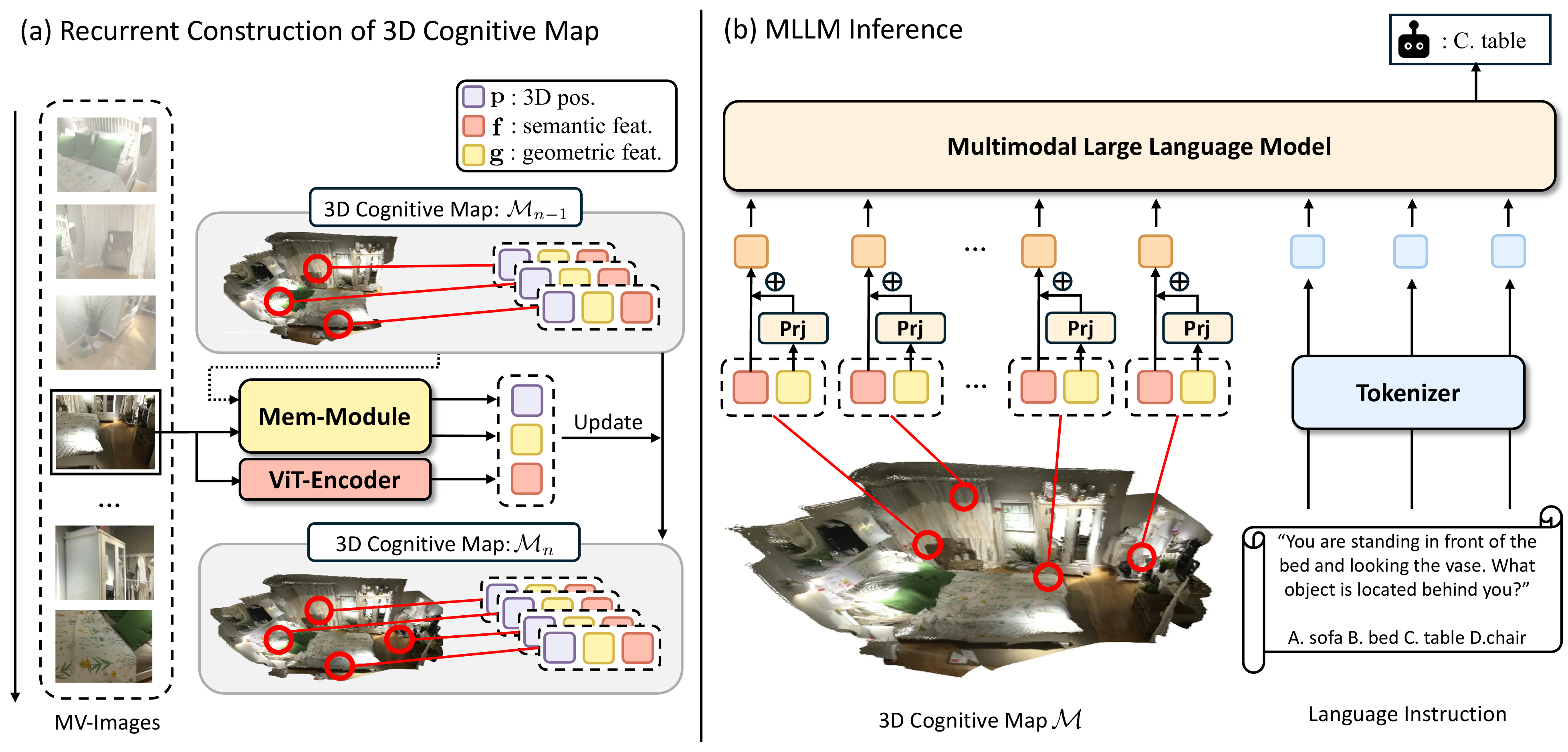
Overall pipeline of Cog3DMap

Overall pipeline of Cog3DMap. (a) Given a sequence of multi-view images, our recurrent framework progressively integrates visual observations into a unified 3D memory map. Each spatial coordinate in the map is associated with a token carrying both semantic and geometric information. (b) Then, the resulting compact and explicit 3D map is fed into the MLLM decoder for spatial reasoning.

Abstract

Precise spatial understanding from multi-view images remains a fundamental challenge for Multimodal Large Language Models (MLLMs), as their visual representations are predominantly semantic and lack explicit geometric grounding. While existing approaches augment visual tokens with geometric cues from visual geometry models, their MLLM is still required to implicitly infer the underlying 3D structure of the scene from these augmented tokens, limiting its spatial reasoning capability. To address this issue, we introduce Cog3DMap, a framework that recurrently constructs an explicit 3D memory from multi-view images, where each token is grounded in 3D space and possesses both semantic and geometric information. By feeding these tokens into the MLLM, our framework enables direct reasoning over a spatially structured 3D map, achieving state-of-the-art performance on various spatial reasoning benchmarks.
Key Highlights

TL;DR: We build an explicit 3D memory from multi-view images so that VLMs can directly reason over
structured 3D representations, instead of implicitly inferring spatial structure from redundant visual tokens.

Explicit 3D Memory Construction

A recurrent framework that incrementally builds a structured 3D map from multi-view images, progressively integrating new observations into a unified spatial representation.

Compact & Non-Redundant

Unlike prior methods that assign identical 3D coordinates to overlapping view tokens, Cog3DMap maintains a single token per spatial location through a principled memory update mechanism that retains, updates, and expands tokens as new views arrive.

State-of-the-Art Spatial Reasoning

Achieves new SOTA on VSTI-Bench (+8.7%p over previous best), VSI-Bench (+3.9%p), and competitive results on RoboFAC, all while reducing visual tokens by up to 90.2% on long-horizon sequences.

Semantic + Geometric Fusion

Combines semantic features from the MLLM's vision encoder with geometric features from a pretrained Point3R model, creating spatially grounded tokens that enable precise distance estimation, object localization, and spatial relationship reasoning.

Attention Visualization

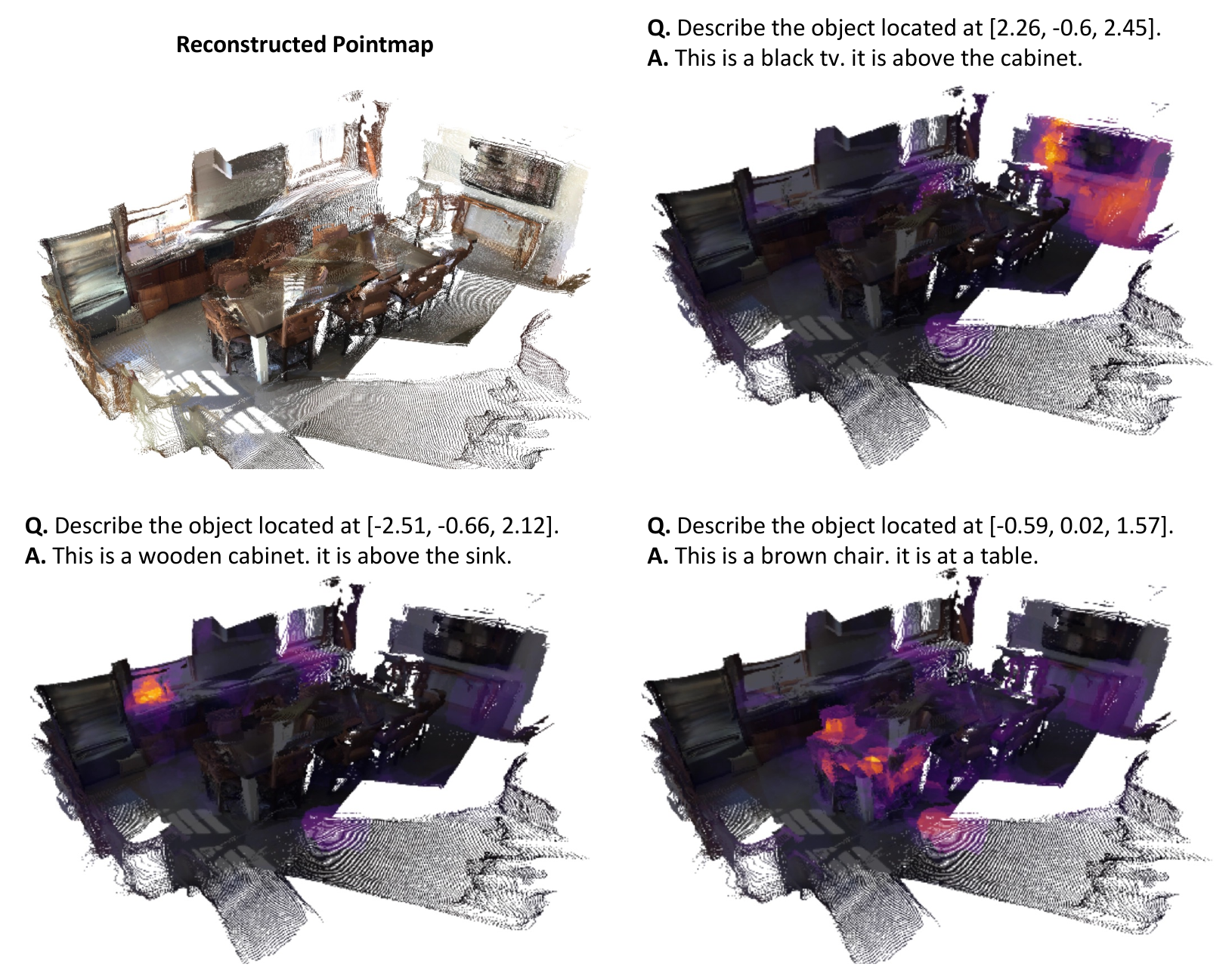
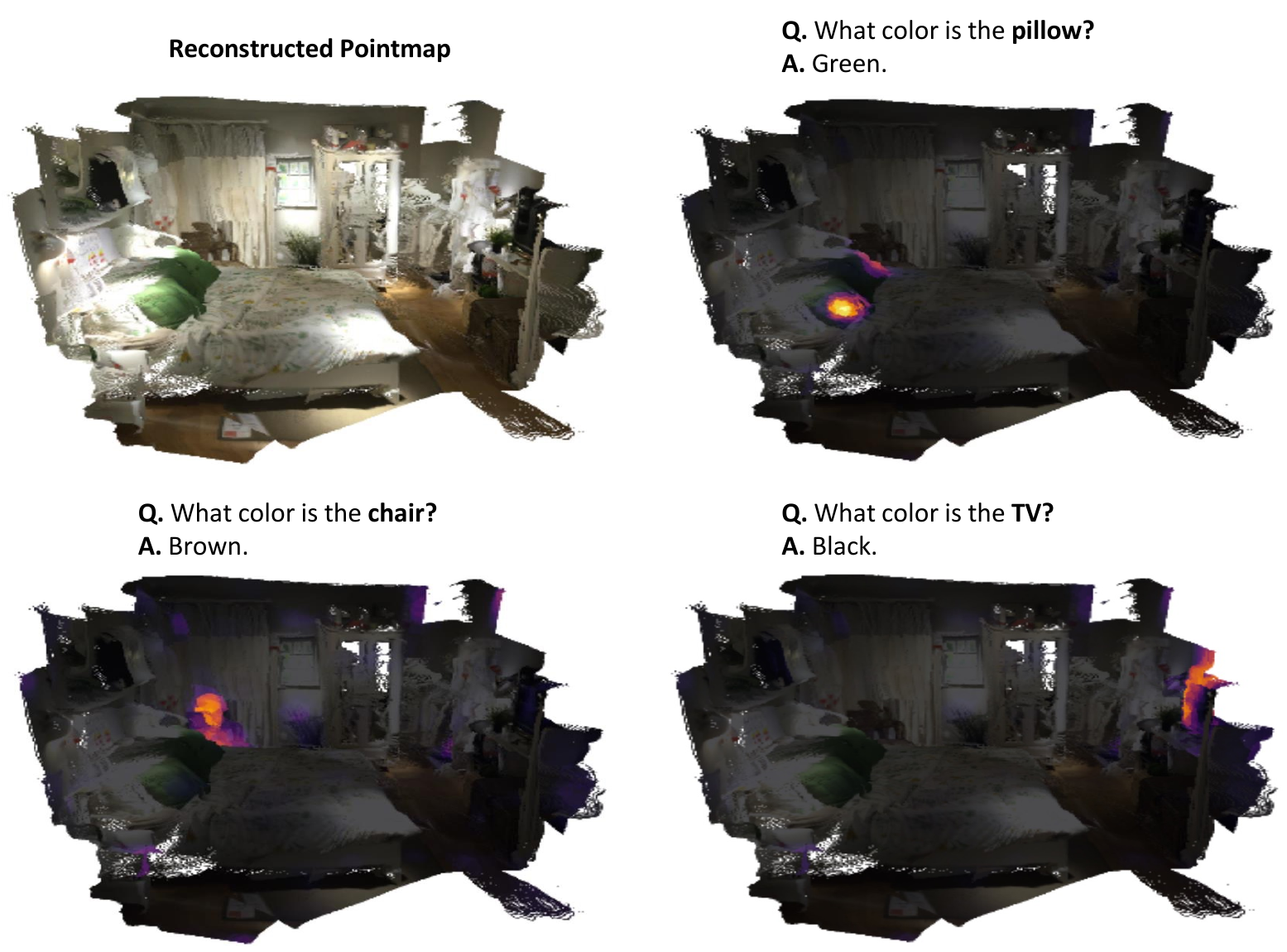
Without explicit spatial supervision, Cog3DMap learns to attend to spatially coherent 3D clusters around queried locations, demonstrating genuine 3D spatial understanding.

Attention visualization across varying text queries

ScanQA style queries. Cog3DMap attends to query-relevant tokens without explicit supervision.

Attention visualization on Scan2Cap

Scan2Cap validation sample. Cog3DMap assigns high attention to visual tokens corresponding to the generated answer.

Results

VSTI-Bench

Model Avg. Cam-Obj. Dist. Cam. Displce. Cam. Mov. Obj-Obj. Pose Cam-Obj. Dist.
Random---36.150.036.1
Human Level77.051.446.895.197.594.3
Proprietary Models (API)
Gemini-1.5-Flash32.128.520.924.452.633.9
GPT-4o38.229.523.437.358.142.5
Open-source Models
LongVILA-8B30.520.011.635.452.333.4
LongVA-7B32.313.55.143.757.941.2
VILA-1.5-8B37.330.127.342.250.436.7
LLaVA-NeXT-Video-7B40.028.21.849.864.755.6
LLaVA-OneVision-7B41.729.919.347.562.149.8
InternVL2-8B43.532.913.548.068.055.0
Spatial-Enhanced Models
VLM-3R-7B58.839.439.660.686.568.6
Cog3DMap-8B (Ours)67.540.947.188.190.970.6

Performance comparison on VSTI-Bench (joint spatial-temporal understanding). Cog3DMap achieves strong performance on spatial reasoning and camera movement prediction, encoding both geometric and temporal cues within a unified 3D representation.

VSI-Bench

Model Avg. Obj. Count Abs. Dist. Obj. Size Room Size Rel. Dist. Rel. Dir. Route Plan Appr. Order
Random- ---- 25.036.128.325.0
Human Level79.2 94.347.060.445.9 94.795.895.8100.0
Proprietary Models (API)
GPT-4o34.0 46.25.343.838.2 37.041.331.528.5
Gemini-1.5-Flash42.1 49.830.853.554.4 37.741.031.537.8
Gemini-1.5-Pro45.4 56.230.964.143.6 51.346.336.034.6
Open-source Models
VILA-1.5-8B28.9 17.421.850.318.8 32.134.831.024.8
LLaVA-OneVision-7B32.4 47.720.247.412.3 42.535.229.424.4
InternVL2-8B34.6 23.128.748.239.8 36.730.729.939.6
LLaVA-NeXT-Video-7B35.6 48.514.047.824.2 43.542.434.030.6
Spatial-Enhanced Models
VG-LLM-4B47.3 66.037.855.259.2 44.645.633.536.4
Spatial-MLLM-4B48.4 65.334.863.145.1 41.346.233.546.3
VG-LLM-8B50.7 67.937.758.662.0 46.640.732.459.2
3DRS-7B45.9 68.734.853.656.6 40.943.230.439.2
VLM-3R-7B60.9 70.249.469.267.1 65.480.545.440.1
VST-7B61.2 71.643.875.569.2 60.055.644.369.2
Cog3DMap-8B (Ours)65.1 69.654.867.867.1 64.885.643.067.9

Results on VSI-Bench (multi-view spatial scene understanding). Cog3DMap achieves state-of-the-art overall performance, particularly on absolute distance, relative direction, and appearance order.

1st 2nd 3rd

RoboFAC

Accuracy (%)

Short-horizon
42.0
82.1
84.8
Med-horizon
37.2
84.1
86.2
Long-horizon
34.8
87.5
87.2

Visual Tokens per Example

Short-horizon
556.8
556.8
407.7
Med-horizon
1478.4
1478.4
460.4
Long-horizon
4684.8
4684.8
460.1
Qwen3-VL-4B RoboFAC-4B Cog3DMap-4B (Ours)

Results on RoboFAC (Robotic Failure Analysis and Correction) benchmark across short, medium, and long task horizons. Cog3DMap achieves competitive accuracy while reducing visual tokens by up to 90.2%.

Demo Video

RoboFAC input video

Cog3DMap reconstruction

BibTeX

@article{gwak2025cog3dmap,
  title   = {Cog3DMap: Multi-View Vision-Language Reasoning with 3D Cognitive Maps},
  author  = {Chanyoung Gwak and Yoonwoo Jeong and Byungwoo Jeon and Hyunseok Lee and Jinwoo Shin and Minsu Cho},
  journal = {arXiv preprint arXiv:2603.23023},
  year    = {2025}
}